In Rand Fishkin's post, he advocates for zero-click marketing as a "different" way to "play the game." Even though the term is relatively new, the concept of zero-click marketing has been around for years. In fact, I wrote about it on my old blog, creatively named... Hiram's Blog. Creative, I know.
In the piece, I wrote about the value that platforms relentlessly claw back once they've got both side of the market locked down. I didn't know it then, but this would lead to another useful term that we need to know, and 2023's word of the year: enshittification.
What is zero-click marketing?
Zero-click marketing refers to a behavior where you don't post links on social media platforms because it results in your posts performing worse than posts that don't link out to other websites.
This happens because platforms want you to create content natively within their platform, since that's what keeps you hooked, locked in, and ultimately the product of that platform.
For example: Let's say you post a video on YouTube. You want to drive traffic to it, so you go to Twitter and post it there too.
You could post a tweet with the link, which would be the easiest thing. Or, you could post the video natively on Twitter.
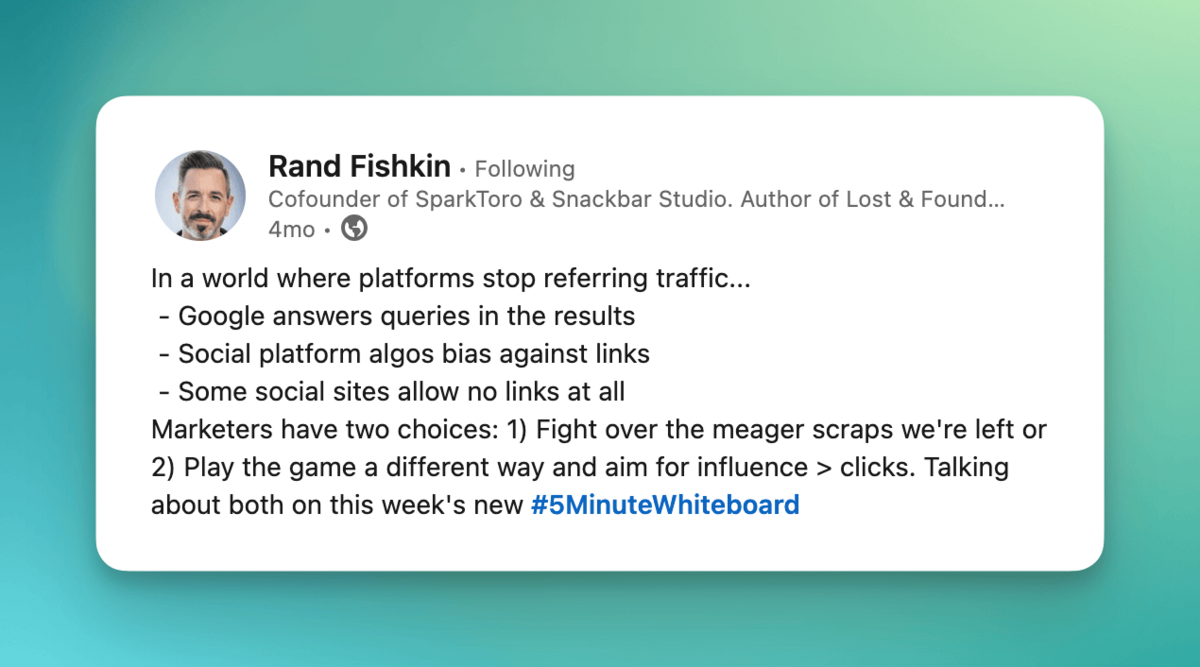
I'm not very active on LinkedIn natively (because I use a third-party tool to post), but I couldn't help think about this advocacy for zero-click marketing.
Let me be clear: there's no debating the data. It's evident that blog traffic is down, and it has gotten increasingly harder to get your voice heard and your words seen on the internet, especially with the rise of AI content.
There's no debate that every platform (LinkedIn, Facebook, Instagram, WhatsApp, Google, Reddit, etc.) wants to keep you locked into their ecosystem. I wrote about this ecosystem war too.
With that said, I can't—in good conscience—advocate for zero-click marketing as a long-term strategy.
The problems with zero-click marketing
Zero-click marketing is a game where we shoot ourselves in the foot, along with everyone else—both marketer or not.
Rand actually acknowledged this—perhaps unknowingly—in his video, when he said:
"You win, zero-click internet. The big platforms... you're gonna take all of our traffic. And that is okay, because I can still have influence by being present in the places where people pay attention."
Rand Fishkin
What zero-click marketing results in is short-term gains for this "influence" that Rand talks about, if you're lucky enough to grab some of that influence.
There are a few issues with this:
1. You have to be lucky enough to grab some of that influence.
2. There's no guarantee that the influence will be significant enough for you to drive meaningful business impact.
3. At the end of the day, that influence is temporary.
4. You remain locked into the platforms that dominate all of our communications, which is rented real estate. So even if you become an A-list celebrity, you'll always be at the mercy of the platform on which you have this "influence."
If they choose to ban you, mute you, lower your influence, restrict you somehow, or just let the ever-changing algorithm do its thing, it's goodbye to you and your "influence."
We've seen this before, and we'll continue to see it until some seismic systemic changes happen.
So here's my question: Do we really wanna "give up" and go into total zero-click (ZC) marketing?
I get that it seems like a losing battle and you could really use that short-term win, but hear me out.
These platforms have so much weight to throw around because we allow them to have that weight. We built up these platforms little by little. Reddit and Facebook are great examples of this.
These platforms are valuable because of us, the people.
We use these platforms to generate content, yet what do we get any value in return? We drive traffic to the site. We invite our friends to join the platform. They get locked in. They start creating content. They make the platform even more valuable.
Forget about getting paid for our content, that's absolutely out of the question when we can't even get some measly traffic out of it because they penalize us for linking out of their platform.
So not only do they control the distribution, they also control the content, and us, by default, becuase we're left to say, "You win, take all my traffic. I'll post the way you want me to. And when you decide to change for your benefit again (secretly, by the way), I'll have to experiment and guess what it is you want me to do yet again."
This makes us indentured servants to the algorithms and the platforms. I'm not sure there's any other way to put it, other than exploitation.
What can we do about zero-click marketing?
These platforms are—and need to be—receptive of our behavior.
What if everyone resisted zero-click marketing?
We're in a time when we're being manipulated in all sorts of ways. In How we need to remake the internet, Jaron Lanier famously says:
...I can't call these things social networks anymore. I call them behavior modification empires.
Jaron Lanier
Every single platform wants us to post natively because they want to hoard all of our attention for themselves. They manipulate us into doing so by telling their algorithms that if our posts contain a link anywhere outside of the platform, that post should not have as much reach or visibility.
This results in people—mostly marketers—who are privy to this, and they start doing zero-click marketing because they notice that their content is performing way better when they don't link out of the native platform. Cool.
The algorithm sees that it's working, and continues manipulating the rest of us into doing the same.
Fast forward. It's years later, and everyone is now doing zero-click marketing.
What's the result?
Trillion dollar organizations have the resources to crank out zero-click content, no problem. Especially with AI-generated content. They can hire more and more social media managers, content creators, prompt engineers, and the like.
But what about everyone else? What if you're an SMB? What if you don't have limitless resources?
To do zero-click marketing, you need to be posting natively across all platforms. In mainstream social media, we've got.
- Threads
- TikTok
- Bluesky (rising)
If you add federated/decentralized/ethical platforms, we've got:
(Four of these are owned and controlled by Facebook, by the way.)
Would you be able to do zero-click marketing as a small/medium business? Not without a lot of time and money. If you're a solopreneur or a startup, forget about it.
This is on top of all the other marketing activities that you need to do.
And that's not even including the other non-marketing activities in general that you need to do to run and sustain a business.
This inevitably leads to a world of zero organic reach.
If zero-click marketing takes over, and organic reach is dead, what's left?
Paid marketing. Pay-to-play. Too bad if you can't afford it. The big players can.
And you might think you're a big player, but there's always a bigger player. It's only a matter of time before that paid marketing budget runs out, assuming you had one in the first place.
Total enshittification.
It's hard to blame marketers for taking the short-term gain at the expense of the long term. After all, we've got KPIs and other metrics to hit. So I get it.
At the same time, I'd be remiss if I didn't send out this warning signal.
Then again, maybe the issue isn't sending out the warning signal itself, but rather 1) ensuring the warning signal is seen, and 2) coordinating enough collective action to not sabotage ourselves in the long term for a chance at short-term gain.
- Web: hiram.io
- Rising Tide (blog): hiram.io/blog
- LinkedIn: @hiramfromthechi
- Mastodon: @hiramfromthechi@mastodon.social